Ignorer la navigation
What Works
Book

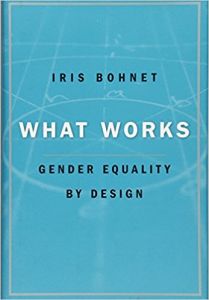
What Works

Gender Equality by Design

Belknap Press, 2016 plus...

Buy the book


Editorial Rating

9

getAbstract Rating

  • Analytical
  • Overview
  • Concrete Examples

Recommendation

Harvard professor Iris Bohnet seeks to determine “what works” when it comes to increasing gender equality. In that pursuit, she offers a focused, meticulous review of efforts to change human behavior to foster inclusion and ethical practice. Bohnet analyzes surveys, lab studies, corporate actions, meta studies and the law from a broad array of disciplines: politics, business, social science, gender studies, and more. The result can be overwhelming, but her prose is always engaging and useful. The author is exceptionally honest. She flatly states how ineffective certain well-intended programs have been. This clarifies her ethical commitment and makes her conclusions more persuasive. getAbstract recommends Bohnet’s insight to anyone interested in clear thinking, social science and a more inclusive society.

Summary

Why “Behavioral Design”

In 1970, only 5% of the performers in the five best American orchestras were female. Now more than 35% are. This didn’t happen by accident. Following the lead of the Boston Symphony, orchestras shifted to blind auditions, wherein judges hear musicians play but don’t see them. Directors always believed they cared only about a musician’s skill. “Unconscious” bias led them to select a majority of men. When they auditioned musicians behind a screen, they chose differently.

Increased gender equality would benefit society. For instance, equality expands the talent pool: Consider how many fine musicians weren’t hired before the advent of blind auditions. When societies exclude women from the workforce, per capita income drops 40%. Yet, some efforts to increase diversity have failed or have had negative effects. Seeing what works requires experimentation.

Unconscious Bias

Unconscious bias is omnipresent and hard to unlearn; it distorts people’s thinking and their perceptions. People expect different things from men and from women in the workplace.

But as employees struggle to put biases aside, behavioral...

About the Author

A native of Switzerland, Iris Bohnet, PhD, is a behavioral economist at Harvard University. She is a professor, the director of the Women and Public Policy Program, and co-chair of the Behavioral Insights Group at the Kennedy School of Government.


Comment on this summary

  • Avatar
  • Avatar
    M. B. 3 years ago
    Great insights for a more inclusive society
  • Avatar
    E. Z. 3 years ago
    thanks for this recomendation
  • Avatar
    L. E. 5 years ago
    Interesting read

More on this topic

Related Skills

Faire progresser sa carrière
AI Transformation
Attirer et recruter des talents
Développer sa créativité
Développer son intelligence émotionnelle
Carrière
Communiquer efficacement
Concevoir des produits innovants
Développer sa capacité de réflexion
Avenir du travail
Création d’entreprise
Direction exécutive
Promouvoir une culture de l'innovation
Ressources Humaines
S'ouvrir aux autres cultures
Innovation
S’auto-diriger
Leverage AI in Your Daily Tasks
Prendre de bonnes décisions
Gérer les performances
Management
Savoir collaborer
Développement personnel
Compétences relationnelles
Understand Economics
Compétences professionnelles
Impulser le changement en douceur
Faciliter le brainstorming de groupe
Promouvoir l'inclusion socio-économique
Façonner la culture d'entreprise
Renforcer sa présence
Nouveaux modèles de travail
Promouvoir l'inclusion ethnique
Renforcer la sécurité psychologique
Défendre les idées nouvelles
Comprendre les comportements humains
Inégalités
Défendre la diversité
Faciliter les discussions
Changer de perspective
Promouvoir la neuro-inclusion
Suivre les progrès de la DEI
Devenir un allié des minorités dans l’équipe
Foster Team Culture
Promouvoir l'inclusion générationnelle
Strengthen Team Collaboration
Se comprendre soi-même
Comprendre les préjugés inconscients
Mener des entretiens d'embauche
Améliorer l'expérience de ses employés
Utiliser l'IA de façon éthique
Comprendre la discrimination
Prendre conscience de soi
Diriger de façon inclusive
Construire une culture inclusive
Évoluer en tant que femme dirigeante
Comprendre la cognition
Manage People and Talent
Créer un sentiment d'appartenance
Tirer parti des Groupes de Ressources pour les Employés
Utiliser le Design Thinking
Promouvoir la diversité, l'équité et l'inclusion
Comprendre la dynamique d'équipe
Lutter contre les microagressions
Comprendre les comportements sociaux
Leadership
Prendre des décisions collectives
Comprendre les inégalités systémiques
Remettre en question les hypothèses
Comprendre les micro-agressions
Promouvoir l'inclusion des femmes
Faire carrière en tant que femme
Atténuer les préjugés cognitifs