
Saltar a navegação
Performance Conversations
Book

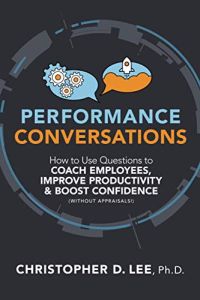
Performance Conversations

How to Use Questions to Coach Employees, Improve Productivity, and Boost Confidence (Without Appraisals!)

SHRM, 2020 mais...

Buy the book


Editorial Rating

8

getAbstract Rating

  • Applicable
  • Concrete Examples
  • For Beginners

Recommendation

The traditional performance review has few remaining adherents. According to longtime chief human resources officer Christopher D. Lee, organizations should replace such reviews with regular, one-to-one feedback sessions between frontline managers and their reports. Lee explains why these conversations are critical to employee engagement, retention and company performance. Moreover, he writes, managers must learn to act as coaches rather than bosses, which means asking the right questions to learn what’s working, what’s not and how to help employees grow.

Summary

Managers should have six-to-twelve, 30-minute performance conversations with employees every year. 

Employees and managers – millennials in particular – despise traditional performance reviews and will leave organizations that insist on using them. This remnant of 20th-century management has no place in the fast-paced, work-from-anywhere world of modern business.

Rather than wait a year, or even six months, to review a person’s performance and then assign a pointless rating, managers should adopt the “Performance Conversations” approach. These conversations address performance (as the name implies) from a coaching perspective. They emphasize servant leadership – managers working in partnership with their reports to achieve performance goals.

Good manager coaches express concern for both the employee and his or her performance. Short (30-minute), regular (6-12 times per year), well-planned, structured and scheduled meetings between team members and manager-coaches develop closer relationships and greater trust. In these semi-formal sessions, managers make their reports feel appreciated and supported, ...

About the Author

William & Mary University’s chief human resources officer Dr. Christopher D. Lee has spent the better part of the past three decades as a Chief Human Resources Officer. He also teaches HR at the University of Richmond.


Comment on this summary

  • Avatar
  • Avatar
    D. W. 3 years ago
    So many managers could find this information helpful...."managers must learn to act as coaches rather than bosses"
  • Avatar
    T. H. 3 years ago
    I love the simplicity of the questions that then lead to great conversation
  • Avatar
    s. a. 4 years ago
    It's very useful for all managers.

More on this topic

Related Skills

AI Transformation
Seja emocionalmente inteligente
Seja um aprendiz autônomo
Torne-se mais adaptável
Carreira
Fomente uma cultura de inovação
Recursos Humanos
Inovação
Lidere com ética
Leverage AI for Leadership
Manage Learning and Development
Gerencie equipes e departamentos
Gestão
Domine a colaboração
Otimize o desempenho da equipe
Planeje e estrategize as suas vendas
Promova diversidade, equidade e inclusão
Vendas
Molde a cultura organizacional
Strengthen Team Collaboration
Habilidades no ambiente de trabalho
Lidere a si mesmo
Gerencie relações trabalhistas
Motive a sua equipe
Implemente o coaching executivo
Avance na carreira
Develop Team Members
Gerencie equipes de vendas
Assuma a responsabilidade pessoal
Comunique-se de forma eficaz
Comunique-se com transparência
Desenvolva autoconsciência
Domine habilidades interpessoais
Promova a tolerância ao erro
Use AI for Coaching and Development
Realize pesquisas com funcionários
Permita-se ser vulnerável
Aceite ser orientado
Aprenda com o feedback
Navegue a política corporativa
Estimule a responsabilidade nas pessoas
Competências comportamentais
Gerencie o seu impacto como líder
Construa segurança psicológica
Defina padrões de desempenho
Gerencie de baixo para cima
Compreenda a si mesmo
Facilite a ideação em grupo
Pratique a humildade
Forneça feedback
Apoie e ajude outras pessoas
Crescimento pessoal
Torne-se um mentorado
Garanta a prestação de contas na equipe
Foster Team Culture
Apoie carreiras na equipe
Cultive uma mentalidade de crescimento
Conduza conversas difíceis
Tenha reuniões produtivas
Manage People and Talent
Implemente programas de coaching
Conduza avaliações de desempenho
Practice Transformational Leadership
Cultive a curiosidade
Destaque-se nas conversas
Facilite discussões
Liderança
Melhore a experiência do funcionário
Gerencie o desempenho
Incentive a comunicação aberta
Melhore o desempenho da equipe
Drive Team Performance
Mentoreie funcionários
Atue como coach do pessoal
Pratique a liderança servidora
Faça perguntas