
Saltar a navegação
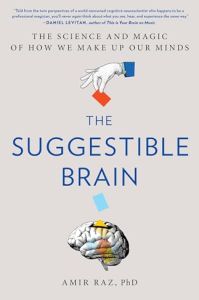
The Suggestible Brain
Book

The Suggestible Brain

The Science and Magic of How We Make Up Our Minds

Hachette Go, 2024 mais...

Buy the book


Editorial Rating

8

getAbstract Rating

  • Applicable
  • Eye Opening
  • Eloquent

Recommendation

The human brain — and mind — is adaptable and vulnerable to suggestion. People can be deceived by everything from magic tricks and persuasive advertising to placebo medications and traumatic life events. Only recently studied by scientists, the power of suggestion can be used for malignant, manipulative ends. But the power of suggestion can also be harnessed to improve people’s mental and physical health — and magnify the meaningfulness of their lives. Everyone is suggestible. But with the help of science and common sense, people can take control of their subjectivity and their lives.

Summary

All humans are vulnerable to the power of suggestion.

As a youth, Amir Raz would perform a simple card trick: He’d invite someone to mentally choose one of five playing cards lying face up on a table — first pointing out that one card was a face card, one was an ace of diamonds, and one was a black card. The other two cards were a four of hearts and a five of diamonds. A majority of the time, the other person would choose the four of hearts, having been subtly pushed away from picking any of the other cards by Raz’s verbal introduction to the trick. This simple example of the power of suggestion — and of people’s suggestibility — is not only applicable to magic tricks. People are prey to suggestion — that is, “influential communication” — in a host of life contexts, from advertising to medicine. But they can also learn to understand how suggestion works, and how to leverage it for empowerment.

The power of suggestion in its myriad forms can be partly described and explained using neuroscience, including neurophysiology and neuroanatomy, and psychology. This science can help explain why suggestion can ...

About the Author

Dr. Amir Raz is an academic and researcher in cognitive neuroscience. He holds the Canada Research Chair in cognitive neuroscience of attention and heads the Cognitive Neuroscience Laboratory at McGill University. His research spans the neural and psychological substrates of attention, suggestion, and self-regulation.


Comment on this summary

  • Avatar
  • Avatar
    W. M. 3 months ago
    Great read.
    "While words express thoughts, it is also true that thoughts follow words."
    The mind truly is fascinating.