
Перейти к содержанию сайта
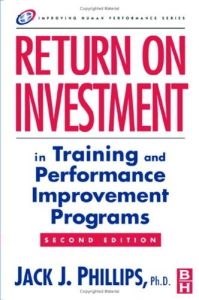
Return on Investment in Training and Performance Improvement Programs
Book

Return on Investment in Training and Performance Improvement Programs

Butterworth-Heinemann, 2003
First Edition: 1997 подробнее...

Buy the book


Editorial Rating

8

getAbstract Rating

  • Applicable

Recommendation

Companies want their training and development programs to succeed in coaching employees and enhancing their career advancement, as well as in contributing to the bottom line, but training’s results can be difficult to quantify. If you’re a training officer, and demonstrating unshakable ROI is at the top of your to-do list, Jack J. Phillips’s calculations can help you prove your programs’ worth. His book is by no means a quick read, but it is a useful one, densely packed with details, instructions, calculations, analyses and case studies – including one highly detailed case history. getAbstract recommends this study on returns to training and development managers and to executives who want to authenticate the fiscal impact of their training and development budget.

Summary

The How and Why of ROI

A quantifiable approach to measuring return on investment (ROI) first emerged in the 1970s in the field of manufacturing. Since then, ROI gauges have spread to various functions in multiple industries, including service, health care, education and nonprofit. An increased desire for “accountability” has made ROI popular. Nearly everyone in business now feels the need to quantify the contributions their departments make to their companies. Most significantly, securing ROI has emerged as a primary goal of high-level executives. Bosses concerned about expanding budgets are pressuring divisions beneath them to demonstrate compelling ROI.

Most companies want to prove that their employee training programs contribute to profitability. However, while almost 80% of firms surveyed noted the importance of ROI in assessing their training programs’ efficacy, only 11% of them actually measure training ROI.

Training and Development ROI

A thorough ROI effort for training and development programs covers the following “five evaluation levels”:

  1. “Reaction and planned action” – Calculate workers’ satisfaction with your program...

About the Author

Jack J. Phillips has a PhD in human resources management. The Jack Phillips Center for Research provides HR advice to companies in the US and worldwide.


Comment on this summary

More on this topic

Related Skills

AI Transformation
Развивайте эмоциональный интеллект
Управляйте своим обучением
Превратите потенциальных клиентов в реальных
Корпоративные финансы
Развивайте навыки мышления
Цифровая трансформация
Discover and Understand Digital Technologies
Drive AI Transformation
Enable Digital Organization
Улучшайте опыт сотрудников
Высшее руководство
Управление персоналом
Инновации
Осуществляйте стратегическое руководство
Управляйте собой
Лидерство
Leverage AI for HR
Управляйте капиталом
Управляйте производительностью
Менеджмент
Освойте продажи B2B
Личностный рост
Стратегически подбирайте должностные роли
Продажи
Софт-скиллз
Изучите тему создания инноваций
Изучите тему организаций
Навыки для работы
Оценивайте инвестиционные проекты
Drive AI Adoption in Teams
Используйте технологии L&D
Develop Team Members
Discover and Understand Data Analytics and Big Data
Внедряйте программы коучинга
Изучите тему человеческого поведения
Управляйте изменениями
Повышайте организационную эффективность
Оценивайте сотрудников
Объясняйте ценность предложения
Управляйте своим влиянием лидера
Manage Learning and Development
Measure AI Business Impact
Руководите людьми в периоды перемен
Изучите тему статистики
Внедряйте программы обучения
Измеряйте влияние L&D на результаты
Manage People and Talent
Изучите тему обучения
Переобучайте и повышайте квалификацию
Use AI for Learning & Development