
跳过导航
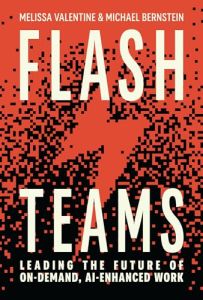
Flash Teams
Book

Flash Teams

Leading the Future of AI-Enhanced, On-Demand Work

MIT Press, 2025 更多详情

Buy the book


Editorial Rating

8

getAbstract Rating

  • Applicable
  • Well Structured
  • Concrete Examples

Recommendation

You need to solve a problem requiring a diverse team of experts, like yesterday.  Melissa Valentine and Michael Bernstein suggest taking advantage of the on-demand global workforce and leveraging artificial intelligence (AI). They explain how to use AI to assemble a crack flash team, a skilled, adaptable group that comes together quickly. Work is increasingly remote, global, and on-demand. Even large corporations rely on flash teams. Now you can, too.

Summary

Build a skilled flash team anywhere, any time.

People or companies may encounter a problem that requires immediate attention from world-class experts, but lack the resources to, for example, put a team on the next flight to somewhere in the world.

The problem could be anything from an industrial accident to a product crisis to a natural disaster. The affected organization needs a team of experts to work together to solve the problem. To pull this resource together, its leaders must leverage AI to assemble an effective team with the skills to adapt to changing circumstances in real time –a flash team.

Today’s workforce isn’t like 1975’s workforce. Then companies needed weeks or even months to find necessary specialists and determine a workable location. It could take ages to bring the right people together, coordinate them, and focus them on the issue. Today, remote work is the norm in certain sectors. AI and online platforms transform hiring, the way people work, and how leaders manage people, projects, and organizations.

Companies such as, for example, Catalant, Gigster, B12, and others developed digital tools to facilitate today’s world of work. Local...

About the Authors

Melissa Valentine is an associate professor in the Department of Management Science and Engineering at Stanford University, where Michael Bernstein is a professor of computer science and a Bass University Fellow. Both are Senior Fellows at the Stanford Institute for Human-Centered Artificial Intelligence (HAI).


Comment on this summary