
跳过导航
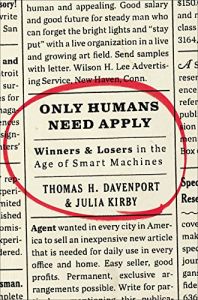
Only Humans Need Apply
Book

Only Humans Need Apply

Winners and Losers in the Age of Smart Machines

HarperBusiness, 2016 更多详情

Buy the book


Editorial Rating

8

getAbstract Rating

  • Innovative
  • Applicable

Recommendation

The automation of tasks is now a threat to all jobs, from menial work to “knowledge work.” Business experts Thomas Davenport and Julia Kirby present the challenges facing employees, today and in future generations. They encourage workers at all levels to prepare. They offer startling predictions about the speed at which smart machines will take over tasks that now require employees with extensive experience and education. This practical guide to remaining relevant in the years ahead proves to be a smart, important read for career planning. getAbstract encourages employees, managers and executives to take heed.

Summary

Three Eras of Automation

Early automation transferred dangerous work to machines, thus improving safety. These technologies introduced more jobs, albeit different ones. In the next stage, automation took over boring and repetitive tasks and allowed human work to become more interesting. Now machines are encroaching on “knowledge work,” the final domain of human intelligence.

Economic Impact

Knowledge workers drive innovation and represent a quarter of the workforce. Scientists, professors, lawyers, doctors, accountants, airline pilots, and many other professionals previously impervious to automation are now at risk. Computer automation will eliminate 47% of the jobs in the United States. For example, in 1980, Wall Street boasted 5,500 traders, but by 2014, only 500 remained. Electronic trading is more cost-efficient and productive.

Machines Can Act and Learn

Machines are good at number analysis, processing words and images, performing digital tasks like changing passwords, and carrying out physical tasks, like the lifting, sorting and packing work that robots at Amazon’s warehouses perform.

Machines that are programmed to do ...

About the Authors

Thomas H. Davenport, a fellow of MIT’s Center for Digital Business, co-founded the International Institute for Analytics and is a professor at renowned business schools. He has written 17 books. Julia Kirby is a contributing editor at The Harvard Business Review.


Comment on this summary

More on this topic

Related Skills

建立和维护福祉
发展组织
Discover Economy
制造行业
创业
Execute Digital Operations
高管领导力
人力资源
领导力
Leverage AI for Cybersecurity
Leverage AI for Leadership
Leverage AI for Sales
Manage Learning and Development
管理
行业市场洞察
精通协作
优化生产
优化劳动力绩效
个人成长
生产与物流
促进多样性、公平与包容
销售
软技能
职场技能
Leverage AI for Product Development
提升员工体验
理解认知
Use AI for Threat Detection
促进代际包容
Understand AI Impact on Learning and Cognition
Build Digital Culture
利用人力资源技术
Manage People and Talent
发展思维能力
Organize for AI
Leverage AI in Your Daily Tasks
Use AI for Workflow Automation
AI Transformation
新兴工作技术
Understand AI Societal Impact
Use AI for Learning & Development
Use AI for Workforce Planning
技术对工作的影响
Leverage AI for Management
Understand AI
Discover and Understand Digital Technologies
实施敏捷管理
Strategize Digital Transformation
新型工作模式
Enable Digital Organization
以德驾驭 AI
Use AI for Skills Matching
利用员工资源小组
Use AI with Company Knowledge
Work Remotely
Discover AI Use Cases
Discover AI Use Cases in the Technology Industry
Drive AI Transformation
Set AI Vision & Strategy
自动化流程
Discover AI Use Cases in the Manufacturing Industry
数字化转型
制造行业未来
Leverage AI Agents
利用学习与发展技术
Use AI for Personal Productivity
Use AI for Learning and Upskilling
未来工作
Plan AI Workforce Transformation
Understand Agentic AI
健康老龄化
劳动力市场趋势
Use AI to Enhance Communication
Understand AI Impact on Work
Leverage AI for HR
Understand AI Capabilities and Limits
Discover and Understand Robotics and Automation
Drive AI Adoption in Teams
Guide Teams Through AI Transition