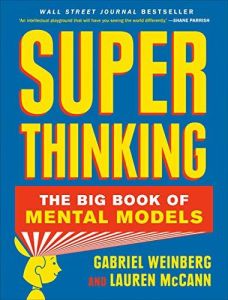
People use mental models – that is, concepts – to approach, analyze, or anticipate decisions and problem-solving. “Super models” imbue you with the power of super thinking to strengthen your decision-making skills. Husband-and-wife team Gabriel Weinberg and Lauren McCann list 300+ mental models from (and applicable to) a wide range of fields to guide you through challenging decisions. Their insightful, fast-paced reference manual offers practical examples you’ll read and return to again and again.
Apply mental models to improve how you make decisions and handle complexity.
Mental models are decision-making frameworks that assist you in making complex decisions and help you differentiate between good and bad ideas. “Super models” provide the power of “super thinking,” which strengthens your decision-making skills. These models function as shortcuts that zip you past “lower-level thinking.”
Investor Charlie Munger, the late vice chairman of Berkshire Hathaway, championed mental models as tools that help you arrange facts into usable structures. Speaking at Stanford Law School in 1996, Munger emphasized that effective multidisciplinary thinking means embracing the best ideas from various disciplines. Mental models help you jump boundaries.
Most mental models aren’t innate, but you can learn and apply them to a variety of categories and situations. After you internalize the models, it’s difficult to consider functioning without them. For example, multiplication is a mental model; it creates greater efficiencies than addition, a simpler model. Once you understand multiplication, you can’t imagine&#...
Gabriel Weinberg is the founder and CEO of DuckDuckGo and the co-author of Traction. Articles by statistician and researcher Lauren McCann, PhD, have appeared in The New England Journal of Medicine.












Comment on this summary