Зарегистрируйтесь на getAbstract, чтобы получить доступ к этому краткому изложению.

Co-Intelligence

Зарегистрируйтесь на getAbstract, чтобы получить доступ к этому краткому изложению.
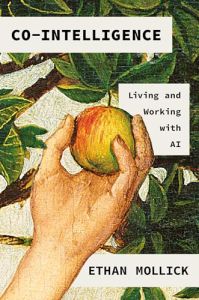
Co-Intelligence

Living and Working with AI

Portfolio,

15 мин на чтение
8 основных идей
Аудио и текст

Что внутри?

A “General Purpose Technology” like generative AI comes along once in a generation — and changes everything.


Editorial Rating

9

getAbstract Rating

  • Comprehensive
  • Applicable
  • Eye Opening

Recommendation

Large Language Model forms of artificial intelligence, like ChatGPT, don’t behave like the machines of years past, business professor Ethan Mollick writes. Interacting with them, you feel that you’re dealing with something profoundly new — a “co-intelligence” — that will radically alter industry, education, creativity, and more. General purpose technologies like generative AI are akin to the invention of the steam engine or the internet, Mollick explains. And while no one knows exactly how generative AI will develop or change humanity, this book offers an intriguing overview of the possibilities.

Summary

Today’s AI operates like an “alien mind.”

People have been fascinated by the idea of thinking machines for centuries. The first mechanical chess-playing machine was introduced in 1770, though it turned out to be a scam. In the 1950s, information theorist Claude Shannon and mathematician Alan Turing articulated the theoretical foundations for artificial intelligence. MIT computer scientist John McCarthy coined the phrase “artificial intelligence” in 1956. Researchers successfully programmed computers to solve logic problems and play games like checkers. However, progress quickly stagnated. Over the years, AI has gone through many similar cycles: rapid leaps forward, usually accompanied by technological advances, followed by periods in which little happens — “AI winters.”

“Supervised learning” uses annotated data, labeled with the right answers for achieving a desired output, to teach an AI system to, for example, recognize human faces or to predict which products you’re most likely to buy. This approach requires vast amounts of data — labeled images of faces or customers’ browsing histories.

If you want...

About the Author

Ethan Mollick is a professor of management at the Wharton School at the University of Pennsylvania. He specializes in entrepreneurship and innovation. He has written for ForbesThe New York Times, and The Wall Street Journal.


Comment on this summary

More on this topic

Related Skills

Узнайте о примерах использования ИИ
Ускорить трансформацию искусственного интеллекта
Предпринимательство
Лидерство
Использование искусственного интеллекта для лидерства
Использование искусственного интеллекта в маркетинге
Использование искусственного интеллекта для разработки продуктов
Маркетинг
Навыки работы на рабочем месте
Обеспечьте внедрение ИИ в коллективах
Трансформация ИИ
Используйте искусственный интеллект для создания изображений и видео
Понимание этического воздействия ИИ
План трансформации трудовых ресурсов с использованием искусственного интеллекта
Понять искусственный интеллект
Этичное использование искусственного интеллекта в качестве лидера
Используйте искусственный интеллект для повышения личной продуктивности
Использование искусственного интеллекта в повседневных задачах
Используйте искусственный интеллект этично
Использование искусственного интеллекта для написания текстов и общения
Узнайте о примерах использования ИИ в образовательном секторе
Направляйте команды в процессе перехода на ИИ
Используйте искусственный интеллект для создания маркетингового контента
Используйте искусственный интеллект для генерации идей
Понимание влияния ИИ на работу
Понимание генеративного искусственного интеллекта