
Зарегистрируйтесь на getAbstract, чтобы получить доступ к этому краткому изложению.

Thinking, Fast and Slow

Зарегистрируйтесь на getAbstract, чтобы получить доступ к этому краткому изложению.
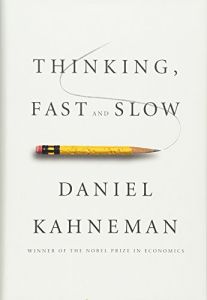
Thinking, Fast and Slow

FSG,

15 мин на чтение
10 основных идей
Аудио и текст

Что внутри?

“Two systems” vie for control of your mind, and “two selves” decide your happiness. Can the four of you ever get along?

1×

Editorial Rating

9

getAbstract Rating

  • Innovative
  • Eye Opening
  • Visionary

Recommendation

The topics that Nobel Prize winner Daniel Kahneman addresses are both complex and integral to the human mind: He asks you to think about thinking by considering how your mind habitually contradicts itself, distorts data, and misleads you. His prose is lucid, his reasoning is rigorous, and his honesty is refreshing – more than once Kahneman illustrates conflicted thinking with examples from his own life. The result is not a fast read, but it’s an ultimately rewarding experience that provides lasting illumination.

Summary

People use two interactive cognitive systems. “System 1” works easily and automatically; it makes quick judgments based on familiar patterns.

When you have to make sense of something, you think about it. To understand this process, consider a model that says people apply two cognitive systems. 

“System 1” is the mental processing function that reads emotions and handles automatic skills, like driving your car or adding two plus two. System 1 takes over your thinking when you set out to comprehend simple statements (such as “complete the phrase ‘bread and . . .”), instinctively turn to see where a noise is coming from, or grimace when you see a gruesome image. System 1 supplies associated meanings (including stereotypes) rapidly and involuntarily.  

“System 2” takes more effort; it requires intense focus and operates methodically.

By contrast, you use “System 2” when you focus on specific details, like counting or figuring out how to complete your income tax forms. System 2 applies effort consciously, such as when you do complicated math, try new physical activities, or search for a specific person in a crowd. System ...

About the Author

Daniel Kahneman, a professor emeritus at Princeton and a Nobel laureate in economics, has written extensively on the psychology of judgment and decision making.


Comment on this summary

  • Avatar
  • Avatar
    N. J. 4 days ago
    For me all i can say is that the question of the two selves spans far back than can be explained. Realizing the line between the two systems and how they both tend to interact with reality danger and work is your successful future.Well i can label these system more biologically as the limbic system and the prefrontal cortex.Different happiness labels one constantly taking account of actions and comparing them against targets and moral compass while the other focuses on the immediate reward of dopamine. Their conflicts trace far back since one has always been there while the other is recent and a gift of evolution.Good staff
  • Avatar
    N. J. 4 days ago
    For me all i can say is that the question of the two selves spans far back than can be explained. Realizing the line between the two systems and how they both tend to interact with reality danger and work is your successful future.Well i can label these system more biologically as the limbic system and the prefrontal cortex.Different happiness labels one constantly taking account of actions and comparing them against targets and moral compass while the other focuses on the immediate reward of dopamine.Their conflicts trace far back since one has always been there while the other is recent and a gift of evolution.Good staff
  • Avatar
    N. J. 4 days ago
    For me all i can say is that the question of the two selves spanas far back than can be explained. Realising the line between the two systems and how they both tend to interact with reality danger and work is your successful future.Well i can label these system more biologically as the lymbic system and the prefrotal cortex.Different hapinness labels one constantly taking account of actions and comparing them against targets and moral compass while the other focusses on the immediate reward of dopamine.Their conflicts trace far back since one has always been there while the other is recent and a gift of evolution.Good staff