跳过导航
AI Demystified
Book

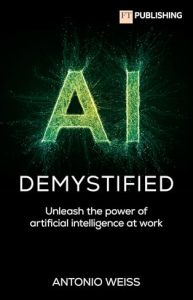
AI Demystified

Unleash the Power of Artificial Intelligence at Work

FT Publishing, 2025 更多详情

Buy the book


Editorial Rating

8

getAbstract Rating

  • Applicable
  • Well Structured
  • For Beginners

Recommendation

Artificial intelligence has existed since the 1950s, but generative AI tools like ChatGPT have the potential to completely transform people’s personal and working lives, senior AI adviser Antonio Weiss writes. Still, even major technological innovations don’t change the world overnight, and the same will likely be true for generative AI: This is just the dawn of the generative AI era. The important thing is to get ahead of the curve. Weiss offers a non-technical guide for how you and your organization can become active participants in the still-young generative AI revolution.

Summary

Generative AI is a general-purpose technology.

Originating in successful code-breaking efforts during the Second World War, artificial intelligence (AI) was always an effort to teach machines to think more or less like humans, but with the speed and accuracy computers are capable of at any given stage in their evolution. In its early incarnations, AI was defined by a set of rules it was programmed to deploy, and for that reason, the sophistication of the tasks AI was able to effectively perform was limited.

Generative AI is different. Its possible applications are manifold. Generative AI can produce novel ideas and content, and thereby solve problems in creative ways. Trained on vast amounts of data from text, images, video, and sound, generative AIs like OpenAI’s ChatGPT deploy large language models (LLMs), in particular, transformers, to determine the statistical relationship between text, visuals, or sounds in sequence and to predict what word, image, or sound will come next. Generative AI models can analyze data and make predictions in a wide variety of areas. And these models can be set up so they continuously improve as...

About the Author

Antonio Weiss is a senior partner at The PSC, the UK’s longest-standing public service specialist consultancy. He has advised the Office for Artificial Intelligence and other organizations seeking AI adoption and digital transformation. He is also an affiliated researcher at the University of Cambridge’s Digital State program.


Comment on this summary

More on this topic

Related Skills

职场技能
在日常任务中利用人工智能,将人工智能工具整合到工作流程中,使用人工智能自动化重复性任务,利用人工智能
创业
领导力
利用人工智能提升领导力,将人工智能洞察融入领导决策,使用人工智能工具增强领导战略,通过人工智能分析推
利用人工智能进行营销,识别营销中的人工智能应用机会,评估用于营销洞察的人工智能工具,比较用于营销任务
利用人工智能进行产品开发,识别产品创作的人工智能工具,将人工智能整合到产品生命周期中,利用人工智能洞
市场营销
理解人工智能,向同事解释基本的人工智能概念,区分人工智能与传统软件解决方案,总结人工智能在现代工作场
使用人工智能进行原型设计,实施人工智能于原型设计过程,利用人工智能工具进行快速原型制作,探索人工智能
发现最新的人工智能进展,跟踪最新的人工智能技术趋势,识别突破性的人工智能研究发展,探索前沿的人工智能
使用人工智能进行图像和视频创作,利用人工智能工具生成宣传视频,使用人工智能软件创建营销视觉,通过人工
了解人工智能对社会的影响,评估人工智能对社会结构的影响,评估人工智能对公共政策的影响,认识人工智能在
发现人工智能的应用案例,识别商业中潜在的人工智能应用,探索人工智能在工作场所改进中的可能性,分析人工
引导团队顺利过渡到人工智能,促进团队适应人工智能工具,准备员工迎接人工智能驱动的角色,管理对人工智能
人工智能转型,实施基于人工智能的流程优化,跨部门整合人工智能解决方案,评估企业采用人工智能的准备情况
使用人工智能进行写作和沟通,利用人工智能撰写商务邮件,使用人工智能工具改善书面报告,整合人工智能以实
理解人工智能对工作的影响,评估人工智能对日常任务的影响,评估人工智能驱动的工作场所变化,识别人工智能
了解人工智能风险,识别商业中的人工智能风险因素,评估人工智能故障的影响,评估人工智能系统中的潜在偏见
编写有效的AI提示,设计高质量的AI工具提示,创建精确的问题以引导AI,构建提示以提取详细的AI输出
使用人工智能生成营销内容,实施人工智能工具进行内容创作,利用人工智能算法自动化内容,使用人工智能技术
利用人工智能生成创意,使用人工智能工具进行头脑风暴,利用人工智能算法增强创造力,利用人工智能生成新产
了解生成性人工智能,识别生成性人工智能机会,探索生成性人工智能的应用,生成性人工智能在商业中的案例研