
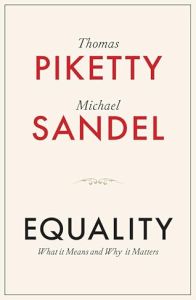
Few public intellectuals have shaped the debate on inequality as decisively as Thomas Piketty and Michael J. Sandel. Piketty, an economist at the École des Hautes Études en Sciences Sociales and the Paris School of Economics, became an unlikely bestselling author with Capital in the Twenty-First Century, his data-rich account of how wealth concentrates over time. Sandel, a professor of government at Harvard, has reached millions through his “Justice” lectures and books such as What Money Can’t Buy and The Tyranny of Merit. In May 2024, the two met at the Paris School of Economics for a public conversation. This slim volume is an edited record of that exchange, and a fine example of how much ground two sharp minds can cover in under 130 pages.
Why inequality matters
The book opens with a deceptively simple question: What exactly is wrong with inequality? Piketty and Sandel go beyond the familiar concerns about unequal access to goods or political influence. Even in a society where everyone’s basic needs were met, they argue, vast gaps in wealth would distort human relationships. When one person can buy a year of someone else’s labor with an hour’s income, the two can hardly meet as equals. Piketty strikes a surprisingly optimistic note: Europe narrowed its income gaps considerably over the 20th century, and even the United States is less unequal today than it was a century ago. Sandel is more troubled by the present, particularly by the toll inequality takes on dignity and civic life.
Comment on this review