
Join getAbstract to access the summary!

The Enduring Impact

Join getAbstract to access the summary!
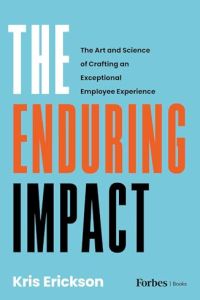
The Enduring Impact

The Art and Science of Crafting an Exceptional Employee Experience

Forbes Books,

15 min read
7 take-aways
Audio & text

What's inside?

Tired of quiet quitting and muted productivity? Use the six tenets of employee engagement to turn your team around.


Editorial Rating

8

getAbstract Rating

  • Overview
  • Background
  • Insider's Take

Recommendation

Employee engagement correlates with higher performance, stronger retention, greater safety, and long-term organizational success, but many employers struggle to improve this crucial metric. In this helpful manual, employee experience consultant Kris Erickson uses data and real-world stories to illuminate six tenets — trust, mission, communication, appreciation, support, and growth — that drive engagement. Learn to build credibility, communicate through change, recognize contributions, support employee development, and create environments where people can do their best work — and want to.

Summary

Employee engagement drives organizational performance; be serious about its six tenets: “trust, mission, communication, appreciation, support,” and “growth.”

Employees’ engagement — their investment in their work — goes beyond whether they feel happy at your company. Their commitment directly influences many business processes and outcomes, particularly the organizational efficiencies that shape productivity, quality, and profitability.

Author Kris Erickson’s consulting team worked with a medical device company, collecting employee engagement surveys for three years before presenting their findings to the firm’s top executives. Midway through the presentation, the CEO took a phone call and left abruptly, never returning. Later, the consultants learned the company had just experienced the largest product recall in its history.

The presenters learned that the recall resulted from work done in the division that reported the weakest engagement scores for three consecutive years. When employees become disengaged, they are less careful, less motivated, and less invested in producing excellent work — thus creating conditions in which costly mistakes are more likely.

About the Author

Kris Erickson is a co-founder and executive consultant at Workforce Science Associates (WSA), an employee experience consulting firm.


Comment on this summary