Join getAbstract to access the summary!

The Failure Advantage

Join getAbstract to access the summary!
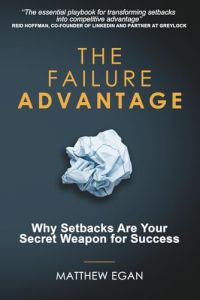
The Failure Advantage

Why Setbacks Are Your Secret Weapon for Success

Matthew Egan,

15 min read
8 take-aways
Audio & text

What's inside?

Playing it safe is costing you dearly. Rewire your relationship with failure.


Editorial Rating

7

getAbstract Rating

  • Applicable
  • For Beginners
  • Engaging

Recommendation

Failure often precedes success. Several publishers rejected J.K. Rowling’s manuscript before Harry Potter became a cultural phenomenon, and Abraham Lincoln lost two Senate races before becoming president. Yet fear of failure keeps many from taking risks that enable growth and happiness. In this engaging read, business transformation expert Matthew Egan offers a practical toolkit to help you transform your relationship with failure, let go of perfectionism, and engineer just the right amount of discomfort to fuel your best work.

Summary

“Radical acceptance” is the antidote to a fear of failure.

Fear of failure limits personal growth. You can’t reach your full potential if you’re afraid to step outside your comfort zone and take risks. In her book The Anxious Achiever, writer Morra Aarons-Mele attributes a fear of failure to several “thought traps,” including the following:

  • “All-or-nothing thinking” — Viewing anything short of perfection as failure.
  • “Catastrophizing” — Assuming the worst-case scenario will come to pass.
  • “Social comparison” — Measuring yourself unfavorably against others.
  • “Labeling” — Seeing your failures as personal flaws.

Left unchecked, these thought traps can stall your productivity — prompting you to overwork to the point of exhaustion, chase paralyzing perfection, or spiral into procrastination.

Failure often triggers more suffering than necessary, due to what Buddhists call “the second arrow”: The “first arrow” is the actual pain failure inflicts; the second arrow is the suffering that comes from your resistance to the experience, which can take the form...

About the Author

Matthew Egan is a business transformation and operations specialist who has led change projects at Microsoft and PwC. He is a Fellow of the Institute of Chartered Accountants.



Comment on this summary