
Join getAbstract to access the summary!
Join getAbstract to access the summary!
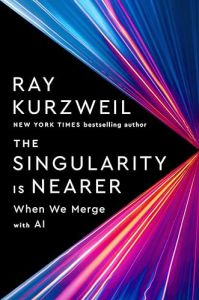
Ray Kurzweil
The Singularity Is Nearer
When We Merge with AI
Viking, 2024
What's inside?
AI technologies are now accelerating forward at an exponential pace, and will transform human life.


Summary availability: Canada, United States
Recommendation
AI is developing at an unprecedented pace, and it’s set to utterly transform human life by the mid-2000s. AI is trending toward a “Singularity” in which humans merge with AI and digital technologies. Computing power is increasing and becoming cheaper by orders of magnitude. Better understanding of neurology, coupled with more sophisticated engineering to support nanotechnology, will enable human brains to connect with AI and the cloud, radically expanding human intellect and consciousness. And as AI develops exponentially, so too will the quality of human life, health, and longevity.
Summary
About the Author
Ray Kurzweil is an inventor, futurist, thinker, and writer. He was the principal inventor of the first CCD flat-bed scanner, omni-font optical character recognition, a print-to-speech reading machine, a text-to-speech synthesizer, a music synthesizer capable of recreating the sounds of a grand piano and other orchestral instruments, and large-vocabulary speech recognition software. He is also the author of many books, including The Singularity Is Near and How to Create a Mind.

Comment on this summary