
Join getAbstract to access the summary!

What Went Wrong with Capitalism

Join getAbstract to access the summary!
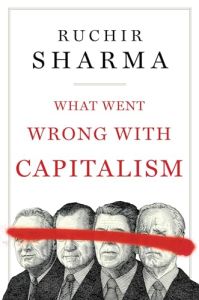
What Went Wrong with Capitalism

Simon & Schuster,

15 min read
8 take-aways
Text available

What's inside?

The financial cure hasn’t fixed the economy’s malaise, writes global financier Ruchir Sharma.


Editorial Rating

9

getAbstract Rating

  • Eye Opening
  • Bold
  • Hot Topic

Recommendation

In this bracing takedown of American capitalism, financier Ruchir Sharma offers a contrarian analysis. The US economy has turned sclerotic and unequal precisely because politicians and policymakers are afraid to let a business fail. During the 1930s Great Depression, Sharma reports, dozens of automakers failed, yet the survivors emerged as efficient, productive enterprises. But today, because government wants to please everyone at all times, the economic system is now clogged with bailouts, subsidies, and unwise regulation. The result, in Sharma’s view, is an economy dominated by billionaires. Readers will find this a thought-provoking perspective on the modern economy.

Summary

Laissez-faire capitalism disappeared decades ago.

Capitalist economies harness the wisdom of the masses. Millions of individual consumers make their own decisions. Each spending decision is similar to a vote for or against a particular product. In fact, capitalism and democracy are closely linked. Both systems endeavor to allow individuals to make decisions for themselves, rather than ceding that authority to a centralized power. It’s worth noting that nearly every developed economy in the world operates in a democratic nation. China is still working its way toward the developed-economy category.

In the United States, the age of small government ended with the Great Depression. The Franklin D. Roosevelt administration created an expansive government that survives today. Since the 1930s, US public spending has been on a steady upswing: Its share of economic output went from just 4% in 1930 to 36% now. Not even Ronald Reagan stemmed the inexorable tide. After eight years in office, he acknowledged that he regretted allowing the public deficit to balloon. In reality, the Reagan revolution did little to slow the growth of big government.

US capitalism has ...

About the Author

Ruchir Sharma is chairman of Rockefeller International and founder of the investment firm Breakout Capital. He is the author of four books, including Breakout Nations and The Rise and Fall of Nations.


Comment on this summary