加入 getAbstract 阅读摘要

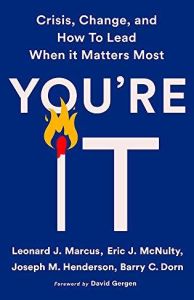
You’re It

加入 getAbstract 阅读摘要

You’re It

Crisis, Change, and How to Lead When It Matters Most

Public Affairs,

15 分钟阅读
8 个要点速记
音频和文本

看看什么内容?

To thrive in a crisis, become a transformative meta-leader with a broad understanding of complex systems.


Editorial Rating

9

getAbstract Rating

  • Innovative
  • Concrete Examples
  • Engaging

Recommendation

The faculty of the National Preparedness Leadership Initiative at Harvard University interviewed the leaders who responded to the 2013 Boston Marathon bombings, gleaning lessons about meta-leadership in a real-world context. They found that meta-leaders in Boston used “swarm intelligence“ to collaborate and mitigate harm. Leonard J. Marcus, Eric J. McNulty, Joseph M. Henderson and Barry C. Dorn draw on these findings to help leaders harness their analytic capabilities and unite diverse people to work together toward a shared vision, especially amid a crisis. The authors’ insights include how to deal with stress and how to reach a nuanced understanding of complex systems.

Summary

Meta-leaders align people around a shared mission and purpose. They understand systems, complexity and adaptive capacity.

In the hours after the Boston Marathon bombings in 2013, a strong response from community members, leaders, care providers and medical personnel helped reduce the impact of the attack. People reacting to the bombings offered successful examples of real-world meta-leadership. Their crisis responses ensured the survival of 264 injured people, though the explosions killed three spectators.

Many of these leaders had attended the National Preparedness Leadership Initiative at Harvard University (NPLI), an executive crisis leadership program, and others had attended its researchers’ meta-leadership seminars. Even though no one acted as an operational leader overseeing the entire bombing response, leaders each reacted effectively by employing “swarm leadership.” Each individual relied on the same consistent set of social cues and behaviors when making decisions and taking action. “Meta” denotes “transforming, above, beyond and at another level” – and these...

About the Authors

Leonard J. Marcus is the founding co-director of the National Preparedness Leadership Initiative, (NPLI), a joint program of the Harvard T.H. Chan School of Public Health and the Center for Public Leadership at the Harvard Kennedy School of Government. Eric J. McNulty is associate director, Joseph M. Henderson is a senior fellow, and Barry C. Dorn is a senior advisor at the NPLI


Comment on this summary

More on this topic

Related Skills

Advance Your Career
AI Transformation
Be Creative
Be Emotionally Intelligent
Career
Communicate Effectively
Develop the Organization
Future of Work
Drive Team Performance
Foster a Culture of Innovation
Foster Team Culture
Human Resources
Innovate Strategically
Innovation
Make Good Decisions
Manage Corporate Communications
Manage Employee Relations
Manage People and Talent
Manage Risk
Management
Marketing
Personal Growth
Plan Strategically
Promote Diversity, Equity, and Inclusion
Shape Organizational Culture
Understand Organizations
Workplace Skills
Develop Your Thinking Skills
Manage Crises
Lead Ethically
Manage Change
Strengthen Team Collaboration
Deal with Difficult People
Embrace Change
Soft Skills
Facilitate Group Ideation
Improve Your Mental Health
Understand Team Dynamics
Lead Strategically
Manage Your Emotions
Understand Social Behavior
Decide Under Uncertainty
Facilitate Discussions
Influence Others
Foster Collaboration
Understand Leadership Approaches
Build and Maintain Well-Being
Increase Your Cultural Awareness
Manage Your Leadership Impact
Cultivate a Growth Mindset
Cultivate Curiosity
Embrace Divergent Thinking
Ensure Business Continuity
Lead Remote or Hybrid Teams
Master Collaboration
Manage Crisis Communication
Practice Servant Leadership
Develop Leaders
Take Group Decisions
Advance as a Woman Leader
Develop Self-Mastery
Emerging Leadership Approaches
Understand Unconscious Bias
Collaborate Across Functions
Navigate Office Politics
Become More Adaptable
Leverage Ambidexterity
Understand Yourself
Build Your Resilience
Understand Cognition
Manage Up
Develop Grit
Leverage AI for Leadership
Navigate Leadership Challenges
Master Interpersonal Skills
Lead Yourself
Drive Change Without Authority
Overcome Challenges
Cultivate Flexibility
Lead through Change
Executive Leadership
Resolve Conflicts
Challenge Assumptions
Lead Through Crises
Practice Transformational Leadership
Develop Self-Awareness
Leadership
Navigate Uncertainty
Mitigate Cognitive Biases
Take Other Perspectives