
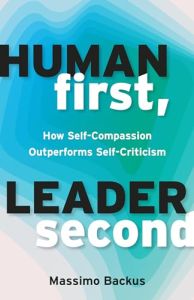
Massimo Backus
Human First, Leader Second
How Self-Compassion Outperforms Self-Criticism
Berrett-Koehler, 2024
What's inside?
Leaders who don’t feel good about themselves can’t feel good about their people. How are you treating you?


Summary availability: Worldwide
Recommendation
Executive coach Massimo Backus shows leaders why they must develop compassion for themselves as they strive to become better at guiding others. He explains that self-compassion is the key to treating those you lead with compassion, as well. He cautions contemporary leaders against practicing the type of cold arrogance that distances them from other people and urges them to honor their basic humanity instead. Backus is fully empathetic, though he does refer to some of his positive case histories as “woo-woo wins.” That’s a misnomer; there’s nothing “woo woo” about a kindness breakthrough, as seen in his clear guidance for adopting self-compassionate leadership based on “awareness, acceptance, and accountability.”
Take-Aways
- Leaders should develop self-compassion, and so should everyone else.
- To become more mindful, connect with your basic humanity.
- Hiding your weaknesses on the job means hiding your true nature.
- Self-compassion is neither soft nor weak.
- The “Ward Model” helps leaders engage in self-compassion more fruitfully.
- Self-compassionate leadership calls for “awareness, acceptance, and accountability.”
- Self-compassionate leadership can replace other outdated leadership practices.
- You only go around once, so be nice to yourself.
Summary
Leaders should develop self-compassion, and so should everyone else.
In 2004, established ABC news anchorman Don Harris suffered an on-air panic attack. At the time, people considered Harris both a gifted TV professional and a cold-hearted diva. To determine what had gone wrong, he agreed to a 360° assessment in which his friends, relatives, professional associates, direct reports, and other contacts would offer solicited, objective feedback.
Their feedback was uniformly critical. It was so negative that his wife had to stop reading it to flee to the bathroom for a good cry. Many of the negative comments concerned Harris’s self-centeredness and anger. Greatly dismayed by people’s overwhelmingly negative opinions, Harris agreed to undergo “psychotherapy, communications coaching, bias training, and couples counseling.” He continued his personal meditation practice. When none of the support he sought made a meaningful difference, he engaged in a nine-day “loving-kindness meditation” retreat.
“The avoidance of suffering is a form of suffering. The avoidance of struggle is a struggle. The denial of failure is failure. Hiding what is shameful is itself a form of shame.” (Mark Manson)
In time, Harris was done with retreats, meditation, and counseling. He’d learned to embrace his inner anger just enough to curse the entire self-help process. In terms of how he treated others, he felt himself regressing. Then a counselor suggested a new course of action: to become kinder to those around him, Harris should start by being kinder to himself. The counselor advised Harris that whenever he felt anger washing over him, he should put his hand on his heart and say to himself, “It’s okay, sweetie. I’m here for you.”
Harris thought this idea was pretty lame, but with nowhere else to turn, he finally gave it a try. The next time he felt anger boiling up, he put his hand over his heart and said to himself, “It’s all good, dude. I know this sucks, but I’ve got you.” And, it worked.
“Lack of love…is at the root of our most pressing problems, from inequality to violence to the climate crisis.” (Don Harris)
By venturing to try this humble act of self-acceptance, Harris began to understand a simple truth: Self-compassion calls for “radical disarmament” with your interior “demons,” now identified as “well-intentioned, misinformed protectors,” or “WIMPs.” When people accept themselves and treat themselves kindly, they disarm their WIMPs and undermine the power WIMPs seize in the internal battle for mental clarity. Self-acceptance depends on embracing the understanding that you are “human first,” before you are your job or your title.
To become more mindful, connect with your basic humanity.
The negative stories most people tell themselves about themselves seriously curtail their overall capabilities and capacities. The best way to put this negative internal dialogue aside is to begin trusting yourself. A compassionate person has an abiding concern for the welfare of others and a strong motivation to assist others when they need help. To build this trait, first develop compassion toward yourself.
“Self-love, properly understood not as narcissism but as having your own back, is not selfish. It makes you better at loving other people.”
Duke University researchers Laura Barnard and John Curry report that self-compassion induces “higher levels of life satisfaction, happiness, self-confidence, optimism, curiosity, creativity and gratitude.” Additionally, they find that self-compassionate people are less anxious, stressed out, or depressed. People with compassion for themselves understand that failure can be a valuable learning experience, but it doesn’t define them. This understanding stems from a refusal to castigate or accuse themselves if they fail. Instead, when things go wrong, they practice self-compassion.
Investing in self-compassion is akin to putting on your own oxygen mask before you put oxygen masks on others. That is, you can’t help them until you help yourself.
“To be human is to be imperfect and fallible and still know that we deserve love and respect.”
Today’s leaders have a shortage of compassion. Some even proudly display its opposite: hate-filled narcissism. Too often, modern leaders forget their basic humanity, exert their power disdainfully, and treat those they lead with coldness or even cruelty. In return, such leaders may feel lonely and detached. They aren’t happy, and they may not know that in order to achieve contentment, they need to become more compassionate toward themselves – and that will enable them to extend compassion to those they lead.
Hiding your weaknesses on the job means hiding your true nature.
Developmental psychologists Robert Kegan and Lisa Lahey maintain that everyone works two jobs. Job one covers the actual work they’re paid to accomplish. Job two concerns the efforts most people make to hide their weaknesses and inadequacies, especially at work. Job two ruthlessly demands that you always present your best side. Not surprisingly, most onlookers see right through this charade.
“It’s natural to want to hide our weaknesses, and acknowledging this behavior is the first step to emerging from the shadows.”
Acknowledge that your attempts to cover your weaknesses are all in vain and that – given that no one is perfect – they are a waste of your time and energy. Instead of giving in to the “tyranny of perfection,” which is never a good idea, try to accept and demonstrate your basic humanity, the true source of your personal power.
Self-compassion is neither soft nor weak.
Many people have the wrong idea about self-compassion. They see it as soft, weak, or too emotional. In fact, it’s just the reverse: self-compassion is tough-minded in the extreme. It keeps people on track to try harder and improve themselves over the span of their lives for their own benefit and for the benefit of those around them.
“Self-criticism and judgment are considered tough and honest, while self-compassion is seen as weak and fluffy....However...practicing self-compassion…actually motivates us to try harder and improve ourselves in the long term.”
As such, self-compassion requires discipline and dedication. Be aware of these common misperceptions about treating yourself compassionately.
- Self-compassion doesn’t embrace or justify “unhealthy coping mechanisms.” It doesn’t involve bad or weak behavior.
- Self-compassion isn’t a cringy form of “toxic positivity,” a weak-minded, denialist problem-solving shortcut that never solves anything.
- Self-compassion isn’t just another way to describe self-esteem, which tells you to accept your shortcomings, but focus on your strengths.
The “Ward Model” helps leaders engage in self-compassion more fruitfully.
Author Massimo Backus developed the “Ward Model,” a mental framework that provides accessible “entry points” where leaders can embark on self-compassionate practices. This mental model is an organizational guide for thinking more clearly. Leaders who use it can quickly reject “self-abandonment” – which many leaders turn to as a default position – and move directly to self-compassion, an emotional state that benefits everyone. The Ward Model’s name derives from the suffix “ward” that is attached to words that denote movement in space or time, such as “forward” or “backward.” Backus developed this name to help leaders remember the ways they can travel to develop their self-compassion.
“You don’t want to beat yourself up for beating yourself up in the vain hope that it will somehow make you stop beating yourself up.” (Kristin Neff)
The Ward Model helps leaders identify and understand their unhelpful WIMPs and achieve a better mental position for handling them. The Ward Model has six on-ramps:
- Inward – Focus on your feelings and “mental states.”
- Outward – Recognize your intent toward the world around you and your impact on it.
- Backward – Think productively about previous experiences and find the lessons within them.
- Forward – Accept your likely positive future and invest in your aspirations.
- Windward – Confront all your challenges straightforwardly. Be accountable for your behavior and prepare to forgive yourself for any errors or missteps.
- Leeward – Find a comfortable, safe place where you can consciously relax and regain your strength.
Self-compassionate leadership calls for “awareness, acceptance, and accountability.”
Explore three domains to learn self-compassion: awareness, acceptance, and accountability. Self-compassionate leadership calls on you to understand your interior emotions, hold yourself accountable as a leader, and accept yourself with empathy, not judgment. Awareness occurs in the “affective domain,” the heart. This domain helps you understand your emotional states and the ideas that each state can spark. Staying in your heart allows you to remain fully aware of your emotions.
“If you are distressed by anything external, the pain is not due to the thing itself, but to your estimate of it; this you have the power to revoke at any moment.” (Marcus Aurelius)
Being aware is only part of the equation. You control your specific awareness — that is, what you deem to be good or bad. Assigning goodness or badness to something is a judgment call, and, in this case, you are the judge. Acceptance takes place mentally as you acknowledge your individual reality: who you are, how you are doing, and what you can and can’t control. Acceptance is essential to individual human stability and happiness.
Accountability derives from your personal values, which you determine based on your heart and your awareness. Leaders are accountable when they live up to their values. They are not behaving accountably when they abandon their values at the first sign of distress or trouble. Accountability enables you to do what you need to do while treating yourself with loving kindness and compassion.
“Because one believes in oneself, one doesn’t try to convince others. Because one is content with oneself, one doesn’t need others’ approval. Because one accepts oneself, the whole world accepts him or her.” (Lao Tzu)
Accountable leaders take a stand. They are able to step out of their comfort zone, no matter how comfortable it may be. As John A. Shedd wrote in Salt From My Attic, “A ship in the harbor is safe, but that’s not what ships are built for.” What are you built for? Whatever it may be, live up to it.
Self-compassionate leadership can replace other outdated leadership practices.
In drown-proofing training exercises for US Navy Seals, trainers tie each participant’s feet together, tie their hands behind their back, and throw them in a nine-foot-deep pool. How do Seals survive this life-threatening ordeal? To survive, participants must deliberately sink to the bottom of the pool. When they hit the bottom, they push upward with their feet. This enables them to grab a quick breath of air at the surface. Then they repeat this process as often as necessary until the training session is over.
The idea is not to fight the scary physics of sinking to the bottom of the pool, but to go calmly with the flow and find a sensible solution even in a situation that would cause many people to panic. This training exercise provides a metaphor for how self-compassionate leadership functions. Counter-intuitively, self-compassionate leaders don’t fight, struggle, or curse their bad luck when they encounter obstacles and problems. They remain calm and remember that they are “perfectly imperfect people” who, thanks to their basic humanity, can ably deal with emergencies as they arise.
“Self-compassion can help leaders learn who they are at their core and what lights them up so they’ll see big ideas and projects through to the end instead of abandoning them after the initial excitement wears off and the first obstacles appear.”
Self-compassionate leadership calls on you to explore yourself fearlessly so you can challenge obsolete emotional responses that no longer serve you. Such responses include blocking your emotions and letting outside forces — such as other people’s opinions — lead you to compare yourself negatively to others. This may mean making personal changes to achieve the caliber of leadership you know you can provide. As author and leadership expert Marshall Goldsmith put it, “What got you here won’t get you there.”
You only go around once, so be nice to yourself.
Backus stretched out in the grass beside a sunlit pond, then he walked to a nearby beach. He heard the seabirds, focused on the wind and the ocean, and settled in to meditate. Afterward, he set up a campsite and started a small fire. He turned each action into a ceremony, giving each step the energy and sanctity it deserved. That night, he sat under the stars and experienced a new clarity which brought him “joy and gratitude.”
Try to start each day happy, serene, and composed. Allow yourself the daily treat of hearing birds sing to you. Get out of the house to experience nature. Enjoy glorious sunsets and the distant, mysterious stars. Take the time for meditation. Seek what works best for you. Free yourself from worry. Be exuberant.Get rid of your WIMPs. Listen to the “lighter, gentler, kinder voice” that lives inside you.
“The full breadth and depth of being human helps us empathize, tap into our resilience, and broaden our emotional fluency.”
Banish the negative thoughts that torment you. Sustain yourself with the positive thoughts that build you up. If you need help, ask for it.
You alone are in charge of your thinking. Start by being kind and compassionate to yourself. Become your own best friend. Make your life’s journey a happy one.
About the Author
Massimo Backus is an executive coach, leadership-development expert, and documentary filmmaker.
This document is restricted to personal use only.
My Highlights
Did you like this summary?
Buy the bookThis summary has been shared with you by getAbstract.
We find, rate and summarize relevant knowledge to help people make better decisions in business and in their private lives.
Already a customer? Log in here.




Comment on this summary